

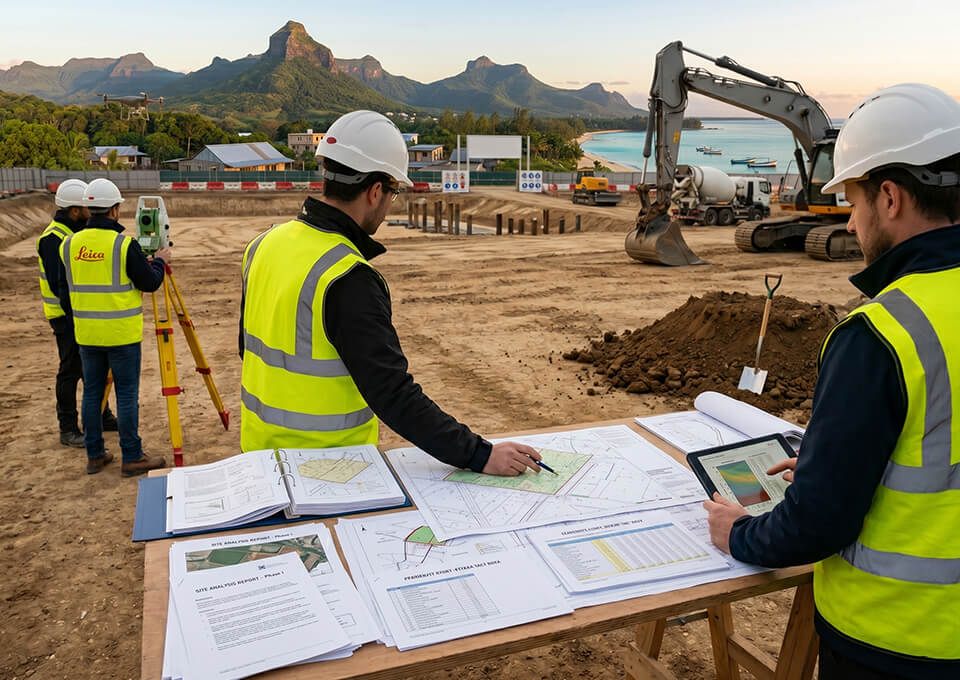
In the Mauritius real estate development market, as in any serious property development environment, the feasibility study is the document that separates informed commitment from speculative hope. It is the analytical foundation on which every subsequent development decision rests: the design brief, the financing structure, the contractor procurement strategy, the marketing programme, and the timeline to delivery. A strong feasibility study does not guarantee project success, but a weak one, or the absence of one entirely, makes failure significantly more likely and considerably more costly.
The Apavou Group has developed some of Mauritius’s most significant commercial and residential projects, including Plaisance Mall, Terre d’Été, and The Cube, over more than four decades of continuous activity on the island. The discipline of thorough feasibility analysis before any major capital commitment has been a consistent feature of the group’s development process throughout that period. It is one of the key factors that distinguishes mature, experienced developers like the Apavou Group from those whose projects consistently underperform their initial projections.
What a Feasibility Study Does
A feasibility study for a Mauritius property development project answers a set of fundamental questions that must be resolved before any significant capital is committed. Is the proposed development appropriate for the site, in terms of zoning, physical characteristics, accessibility, infrastructure availability, and environmental sensitivity? Is there sufficient demand for the proposed product at the price levels necessary to make the project financially viable? What will the development actually cost, in terms of construction, professional fees, financing costs, marketing, and the contingencies that experience consistently shows are needed? What return does this yield on the capital invested, and is that return adequate compensation for the risks being taken and the opportunity costs of the capital?
These questions sound straightforward, but answering them rigorously requires a significant investment of analytical effort, market research, professional expertise, and intellectual honesty. The answers are often less comfortable than a developer would wish, finding that a project is not viable at the originally conceived scale or specification, or that market demand will not support the pricing needed to achieve the target return, is genuinely painful information. But it is infinitely less painful to receive it before breaking ground than after, after capital has been committed, contractors engaged, and expectations raised with investors, partners, or buyers.
Market Demand Analysis in the Mauritius Context
The demand analysis component of a Mauritius feasibility study must grapple with several specific characteristics of the island’s market. For residential development, this means understanding the balance between domestic and international demand for the proposed product type, the specific preferences of target buyer profiles, European buyers have different expectations from South African or Indian buyers, and all differ significantly from local Mauritian buyers, the pipeline of competing supply in the same segment and location, and the regulatory framework governing foreign ownership that shapes the available buyer pool for IRS, PDS, or Smart City scheme properties.
For commercial development, as directly relevant to projects like Plaisance Mall and The Cube in the Apavou portfolio, the demand analysis must examine the active occupier market in detail: what types of tenants are currently seeking space in the Mauritius market, what are their space requirements and budget parameters, what competing space is available to them, and how does the proposed development’s location, specification, and pricing compare to their current and pipeline alternatives? This analysis requires direct engagement with active tenants, their advisers, and commercial agents, not just desk research on published market data, which in the relatively thin Mauritius market can be misleadingly aggregated or out of date.
Why Mauritius Market Data Requires Local Interpretation
Published market data for Mauritius real estate, transaction volumes, average prices, vacancy rates, rental levels, is less comprehensive and less reliably granular than equivalent data for major continental property markets. The island’s market is relatively small, transactions are not always reported in full detail in publicly accessible records, and published averages can mask significant variation between sub-markets and asset quality tiers. A feasibility study that relies primarily on published aggregate data without supplementing it with direct primary market intelligence, gathered through conversations with active agents, tenants, lenders, and competing developers, is likely to produce projections that do not accurately reflect market reality for the specific project being evaluated. This is one area where local expertise and long-term market presence, as embodied by the Apavou Group’s four decades of continuous activity in the Mauritius market, provides an analytical advantage that cannot be replicated by external consultants working from secondary data alone.
Cost Analysis, Getting the Numbers Right From the Start
The cost analysis component of a feasibility study must cover the full project cost, not just construction, but everything required to deliver the completed, occupied, income-generating asset. In Mauritius, a complete and honest project cost model covers land acquisition cost including all transfer taxes and registration duties, site preparation and infrastructure costs including any necessary utility upgrades, construction cost including appropriate provisional sums and contingency allowances, professional fees for architects, engineers, project managers, quantity surveyors, legal advisers, and specialist consultants, financing costs including interest during construction and all arrangement and commitment fees, marketing and sales costs for residential development including show home construction and international marketing, and working capital requirements for the pre-opening and lease-up period of commercial or hospitality developments.
Each of these cost categories carries different levels of certainty at the feasibility stage, and a well-constructed cost model clearly distinguishes between elements that are firmly established and those that carry significant uncertainty. Contingency provisions, typically 10 to 20 percent of construction cost at feasibility stage, reducing progressively as design is developed and specification confirmed, should be sized to reflect the genuine risk of cost overrun for the specific project type and site conditions rather than set at the minimum level that makes the financial model produce the desired return.
Financing Structure and Its Impact on Mauritius Development Feasibility
The financing structure of a development project, the mix of equity and debt, the terms of the debt facility, and the timing of capital flows, has a significant impact on the feasibility analysis and on the sensitivity of the project’s returns to adverse outcomes. High leverage reduces the equity capital required and amplifies equity returns when the project performs as expected. But it increases the project’s sensitivity to cost overruns or programme delays and creates refinancing risk if the project is not completed and income-generating by the time debt facilities reach their maturity.
For development projects in Mauritius, the availability and terms of construction financing from local and international banks are important inputs to the feasibility analysis. Local bank financing in Mauritius is generally available for quality developments by established developers with demonstrable track records, but the terms, loan-to-value ratios, interest rates, covenant packages, and drawdown conditions, vary between lenders and must be understood in detail before the financial model can be finalised. The Apavou Group’s long-established banking relationships in Mauritius provide meaningful advantages in accessing financing on terms that support project viability while maintaining appropriate financial discipline.
Risk Assessment, The Part Most Often Undercooked
The risk assessment section of a feasibility study is the component that most developers most consistently underinvest in. Identifying the key risks to project viability, and honestly assessing their probability and potential impact, is analytically challenging and psychologically uncomfortable for developers who are committed to making a project work. But it is also the section that most clearly distinguishes a credible feasibility study from a promotional document dressed in analytical clothing.
For a Mauritius development project, key risks include construction cost overrun (particularly relevant given the island’s dependence on imported materials, the specialist nature of certain construction requirements, and the logistics challenges of island-based construction), programme delay (driven by the specific challenges of the Mauritius planning system, weather risk, and import lead times), demand shortfall (particularly for residential schemes targeting international buyers whose purchasing decisions are sensitive to global economic conditions and changes in Mauritius investment framework), and financing risk (the risk that debt financing is not available at the terms assumed at feasibility stage, or must be refinanced at worse terms during the construction period).
The Feasibility Study as a Genuine Decision Gate
The ultimate purpose of the feasibility study is to inform a genuine decision, to proceed, to proceed with modifications to reduce identified risks, or not to proceed. A feasibility study that produces the answer the developer wanted regardless of what the honest analysis shows is not a feasibility study. It is a retrospective justification for a decision already made. This distinction matters because the value of the feasibility study as a risk management tool depends entirely on its analytical integrity.
For the Apavou Group, the feasibility study is a genuine decision gate, a point in the development process where the evidence is examined honestly and the project is either authorised to proceed, sent back for redesign to address identified weaknesses, or set aside in favour of alternative opportunities that offer a more compelling risk-adjusted case. This discipline, maintained consistently across decades of development activity in Mauritius, has produced the track record of successful project delivery across Plaisance Mall, Terre d’Été, The Cube, and other landmark Mauritius developments that defines the group’s standing in the island’s real estate market.
Investing in Knowledge Before Investing in Land
The feasibility study represents an investment in knowledge before an investment in land, construction, and capital. For any significant development project in Mauritius, whether a residential scheme in the PDS or Smart City framework, a commercial development, or a mixed-use project, this investment in knowledge is the most reliable investment the developer can make. The cost of a thorough feasibility study is modest relative to the total project cost, and it is invariably modest relative to the cost of a project that fails or significantly underperforms because the questions the study should have answered were either never asked or answered dishonestly. In the Mauritius development market, as the Apavou Group’s long experience demonstrates, analytical rigour before capital commitment is the foundation of sustained development success.
 Previous Post
 Next Post