

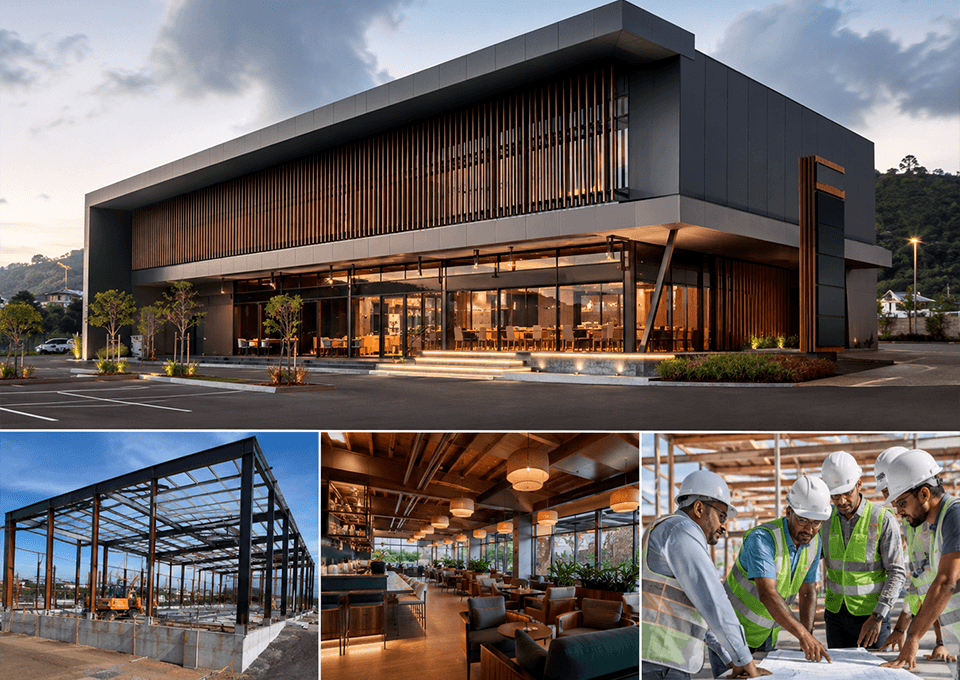
Every large development project moves through a series of distinct phases, each with its own risks, decision points, and opportunities for value creation or destruction. Few projects illustrate this lifecycle as clearly as The Cube, a mixed-use development delivered by Apavou Group that combines office, retail, and service functions within a single Mauritian landmark. Tracing its journey from concept to completion offers a practical illustration of how disciplined development execution actually works, beyond the simplified narrative of “planning, building, opening” that often gets told after the fact.
Concept formation and feasibility
Every development begins long before construction, with a period of concept formation that tests whether an idea is genuinely viable before any significant capital is committed. This stage involves assessing site suitability, studying comparable developments, and stress-testing assumptions about demand for each functional component the project intends to include. For a mixed-use project like The Cube, this meant evaluating office demand, retail footfall potential, and the broader appetite in the Mauritian market for a genuinely integrated multi-use development, rather than simply assuming that combining functions would automatically create value. It also meant examining how comparable mixed-use projects elsewhere in the region had actually performed once operational, rather than relying purely on theoretical models of how such a development should perform under ideal conditions.
This feasibility work is rarely glamorous, but it disproportionately determines a project’s eventual success. Projects that skip or rush this stage, moving quickly to design and construction based on optimistic assumptions, tend to encounter costly surprises later, when the market’s actual response to the finished product diverges from what was assumed at the outset. Groups with a long development history in Mauritius tend to invest more heavily in this early feasibility work precisely because they have seen, across previous projects, how expensive it is to correct course once construction is already underway. This lesson, learned the hard way on earlier, smaller projects, tends to shape a permanent institutional bias toward more rigorous upfront feasibility analysis on every subsequent project, regardless of how confident the team might otherwise feel about a given opportunity.
Design development and stakeholder alignment
Once feasibility is established, the design development phase translates a conceptual vision into detailed architectural and engineering plans. For a mixed-use project, this stage requires careful coordination between architects, engineers, and future operational stakeholders, property managers, leasing teams, and prospective anchor tenants, to ensure the physical design actually supports how the building will function once occupied.
This is also the stage where many of the trade-offs discussed only abstractly during feasibility become concrete: how much floor area to allocate to office versus retail, how to design vertical circulation that serves both functions without creating congestion or confusion, and how to structure building systems (climate control, security, parking) that must serve genuinely different tenant needs simultaneously. Getting this stakeholder alignment right during design, rather than discovering misalignment during construction or after opening, is one of the clearest markers of a well-managed development process.
Permitting and regulatory navigation
Large-scale developments in Mauritius must navigate a permitting process that touches on land use, environmental impact, building codes, and increasingly, climate resilience standards given the island’s cyclone exposure. For a mixed-use project of The Cube’s scale, this regulatory navigation is more complex than for a single-use development, since different aspects of the project may fall under different regulatory considerations depending on their specific function.
Groups with an established relationship with local regulatory bodies, built up over many previous projects, generally navigate this process more efficiently than first-time developers, not because of any improper influence, but because they understand more precisely what documentation and analysis regulators expect, and can prepare submissions that address likely concerns proactively rather than reactively responding to requests for additional information that delay the approval timeline.
Construction management and cost discipline
Construction is where a project’s financial discipline is tested most directly. Cost overruns and schedule delays are endemic risks in construction globally, and Mauritius’s dependence on imported building materials adds a layer of supply chain risk that developers must actively manage, securing materials ahead of anticipated shortages, building schedule buffers around shipping and customs timelines, and maintaining contingency reserves sized realistically based on past project experience rather than optimistic best-case assumptions.
For The Cube, managing this construction phase successfully required coordinating multiple, functionally distinct construction workstreams simultaneously; the specific building systems required for office space differ meaningfully from those required for retail space, even when they’re being built within the same physical structure. This parallel complexity increases the coordination burden on construction management relative to a single-use project of comparable size.
Pre-leasing and market validation during construction
Sophisticated developers don’t wait until construction is complete to begin engaging the market. Pre-leasing activity during the construction period, securing anchor tenant commitments, gauging market interest in remaining space, serves two purposes simultaneously: it provides crucial market validation that the project’s original demand assumptions remain sound, and it reduces the leasing risk the project faces at delivery, when an under-leased building can quickly become a significant financial drag.
For The Cube, this pre-leasing phase likely involved balancing the benefit of securing anchor tenants early against the risk of committing to lease terms before the building’s final specifications were fully locked in, a trade-off that requires careful timing and negotiation skill, particularly for a mixed-use project where anchor tenants across different functional components may have different priorities and timelines.
Delivery and the transition to operations
The formal completion of construction marks an important milestone, but it is not the end of the development process. The transition from construction to operations, commissioning building systems, finalising tenant fit-outs, and building out the operational team that will manage the property on an ongoing basis, represents its own distinct phase with its own risks, particularly for a mixed-use property where operational complexity is inherently higher than for a single-use building.
Projects that treat this transition phase as a genuine priority, rather than an afterthought following the more visible milestone of construction completion, tend to achieve smoother, faster stabilisation, reaching full occupancy and normalised operations more quickly than projects where this transition receives inadequate planning and resourcing.
Coordinating supply chains across a multi-year timeline
Mauritius’s dependence on imported building materials introduces a supply chain dimension to development execution that developers in larger, more self-sufficient markets don’t need to weigh as heavily. For a project spanning several years, like The Cube, this requires planning around material procurement, securing key materials or components well ahead of when they’re needed in the construction sequence, maintaining relationships with multiple suppliers to reduce dependence on any single source, and building schedule contingency around the shipping and customs clearance timelines that inevitably introduce variability beyond what a purely domestic supply chain would involve. Groups with an established import and logistics network, built up over previous projects, generally navigate these supply chain dependencies more smoothly than developers encountering them for the first time.
Beyond procurement timing, supply chain planning also involves qualifying alternative suppliers for critical materials, so that a single supplier’s disruption doesn’t stall an entire workstream, and building realistic buffer time into the master schedule specifically to absorb the kind of shipping delays that are a routine, if unpredictable, feature of operating on an island economy dependent on maritime trade for the bulk of its construction inputs.
Managing the human dimension of a multi-year project
Behind every phase of The Cube’s development lies a human dimension that is easy to overlook in a purely technical account of feasibility, design, permitting, and construction. Large projects retain the same core project management team across multiple years, and the continuity of that team, their accumulated understanding of the project’s specific history, prior decisions, and the reasoning behind them, is itself a valuable asset that is difficult to replace mid-project. Turnover among key project personnel during a multi-year development often introduces avoidable risk, as new team members inevitably require time to absorb the accumulated context that departing personnel carried with them.
Groups with a strong institutional culture and a track record of retaining experienced staff across successive projects tend to benefit from this continuity advantage, reducing the disruption risk that affects projects reliant on a more transient project team assembled fresh for each new undertaking.
Balancing speed and quality across the development timeline
A recurring tension throughout any development’s journey from concept to completion is the trade-off between speed and quality. Market conditions can shift meaningfully over a multi-year development timeline, creating pressure to accelerate delivery to capture a favourable market window. But rushing key decisions, finalising design before adequate stakeholder alignment, and compressing construction schedules in ways that compromise quality control often produces problems that cost considerably more time and money to correct after the fact than the time saved by rushing in the first place.
For a project as complex as The Cube, striking this balance required distinguishing between genuinely time-sensitive decisions, where delay carries real opportunity cost, and decisions where investing additional time in getting the details right produces a meaningfully better long-term outcome, a distinction that requires judgment built from experience with how similar trade-offs have played out on previous projects.
Handling scope changes without derailing the project
Almost every large development encounters pressure to modify its original scope at some point during the multi-year journey from concept to completion, a prospective anchor tenant requesting design modifications as a condition of signing, a shift in market conditions suggesting a different unit mix would perform better, or simply the accumulated insight gained as the project team’s understanding of the market deepens over the course of the development. Managing these scope change requests without derailing the broader project timeline and budget requires a disciplined change management process, clear criteria for evaluating which changes genuinely improve the project’s ultimate value enough to justify their cost and schedule impact, and which represent scope creep that should be resisted or deferred to a future phase or project.
Projects without this kind of disciplined change management process are vulnerable to a slow, cumulative erosion of both budget and schedule, as individually reasonable-seeming changes accumulate into a materially different, more expensive, and more delayed project than originally planned, a pattern that experienced developers actively guard against through structured governance over scope change decisions throughout the development journey.
Documenting decisions for future reference
A final, often overlooked element of the development journey involves the discipline of documenting key decisions and the reasoning behind them as the project unfolds, not simply as a compliance exercise, but as a genuine knowledge asset that supports both effective management of the current project and more informed decision-making on future projects. For a complex undertaking like The Cube, this documentation might cover the rationale behind key design trade-offs, the assumptions underlying the original feasibility case, and the specific lessons learned when actual conditions during construction diverged from original expectations.
Groups that maintain this documentation discipline consistently across successive projects build a genuinely cumulative organisational knowledge base, allowing each new project to benefit from a considerably richer well of accumulated experience than would be available to an organisation that treats each project as an isolated undertaking with limited connection to those that came before it.
What The Cube’s development journey teaches other developers
Tracing The Cube’s journey from concept to completion surfaces several transferable lessons for developers approaching comparable projects in Mauritius or similar markets:
Invest disproportionately in early feasibility work, since errors caught at this stage are dramatically cheaper to correct than errors discovered during or after construction.
Treat stakeholder alignment during design as a critical risk-reduction exercise, not a bureaucratic formality.
Build realistic contingency into both construction budgets and schedules, informed by actual past project experience rather than optimistic assumptions.
Begin market engagement well before construction completion, using pre-leasing activity as both a risk-reduction tool and a validation mechanism.
Resource the transition to operations as seriously as construction itself, since a rocky stabilisation period can undermine even a well-executed construction phase.
Conclusion
The journey from concept to completion for a project like The Cube illustrates that successful development execution isn’t defined by any single phase, but by the consistency of discipline applied across every stage: feasibility, design, permitting, construction, pre-leasing, and operational transition. Each phase carries its own distinct risks, and a lapse in discipline at any single stage can undermine the value created by disciplined execution elsewhere. For developers studying how Apavou Group approaches complex, multi-functional projects, The Cube’s development journey offers a genuinely instructive, phase-by-phase case study.
 Previous Post
 Next Post