

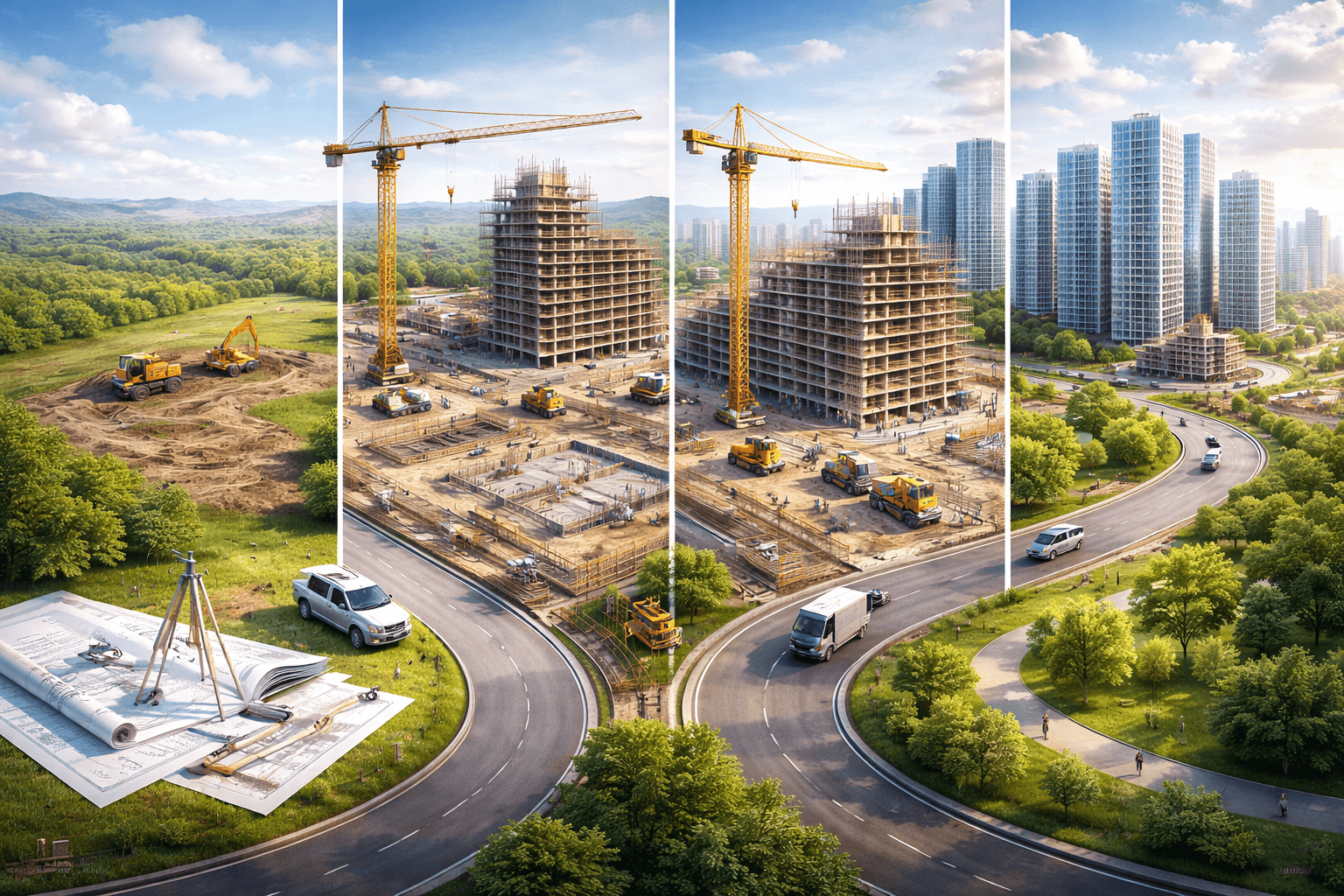
Property development is a process, not an event
Property development is often perceived as a visible outcome: a finished building, a delivered project, or a completed asset. In reality, development is a long, structured process that begins well before construction and continues long after delivery.
In Mauritius, where land is limited, regulations are structured, and development decisions have lasting impact, understanding each phase of property development is essential. Errors made early are rarely corrected later. Conversely, discipline applied at the start often determines long-term success.
The development philosophy historically associated with Armand Apavou and the broader Apavou Group reflects this understanding. Projects were approached as sequences of deliberate stages, each requiring analysis, coordination, and foresight rather than speed.
This article explores the key phases of property development, from land evaluation to delivery, beginning with the earliest and most decisive steps.
Land identification and strategic intent
Choosing land is a strategic decision
The first phase of property development is not design or financing. It is land selection. Land determines what is possible, what is permitted, and what is viable over time.
In Mauritius, land carries multiple layers of consideration: zoning, accessibility, environmental constraints, infrastructure capacity, and surrounding uses. Long-term developers evaluate land not only for current conditions but for how its context may evolve.
Strategic land selection considers proximity to infrastructure, employment zones, residential demand, and long-term planning direction. A well-located site can compensate for many challenges, while a poorly chosen one limits even the best design.
Aligning land with development purpose
Land must align with intent. Residential projects require different conditions from commercial or hospitality developments. Successful developers define purpose early and ensure land selection supports it.
This alignment has historically been central to projects associated with the Apavou Group, where land was evaluated against long-term use rather than speculative opportunity.
Feasibility analysis and development clarity
Feasibility is more than financial modelling
Once land is identified, feasibility analysis begins. This phase determines whether a project should proceed, not how quickly it can.
Feasibility includes financial modelling, but also regulatory review, technical constraints, market demand, and risk exposure. In Mauritius, this means analysing planning permissions, density allowances, environmental impact requirements, and infrastructure availability.
Long-term developers resist the temptation to force feasibility to fit expectations. Instead, they allow data and constraints to shape the project.
Market context and demand assessment
Understanding demand is critical. Developers analyse who the end users will be, what they need, and how demand may evolve over time.
In property development, demand is not static. Economic shifts, demographic changes, and sector growth influence viability. Long-term feasibility considers not only initial absorption but sustained relevance.
Regulatory framework and planning alignment
Regulation shapes development outcomes
Planning and regulatory frameworks are not obstacles to overcome; they are structures to work within. In Mauritius, regulatory clarity plays a significant role in development certainty.
Developers review zoning, land use designations, height limits, density controls, and environmental obligations early. Projects aligned with planning intent progress more smoothly and face fewer long-term constraints.
Reducing future risk through compliance
Developments that stretch or ignore regulatory boundaries may succeed initially but face limitations later. Compliance protects adaptability, resale potential, and long-term operation.
The disciplined approach to regulatory alignment associated with Armand Apavou reflects an understanding that compliance is a form of risk management, not a constraint on creativity.
Concept development and master planning
Translating feasibility into form
Once feasibility is confirmed, concept development begins. This phase transforms data into spatial logic.
Master planning defines layout, circulation, access points, density distribution, and relationship with surroundings. It sets the foundation for architectural and engineering work.
In Mauritius, where land optimisation must be balanced with environmental and social considerations, master planning plays a decisive role in project acceptance and performance.
Designing for coherence, not excess
Strong concepts are coherent rather than excessive. They balance built form with open space, circulation with accessibility, and density with livability.
Long-term developers prioritise clarity and usability over visual complexity. Projects that are easy to understand, navigate, and maintain tend to age better.
Architectural coordination and design development
Architecture as a functional discipline
Architecture in development is not about aesthetic expression alone. It is about translating intent into buildable, usable spaces.
Design development involves refining layouts, aligning form with regulations, and ensuring usability for end users. Developers coordinate closely with architects to ensure design decisions remain aligned with feasibility and long-term operation.
This coordination has been a recurring feature in development practices associated with the Apavou Group, where architecture served function and durability first.
Preventing costly revisions later
Early architectural discipline reduces risk during construction. Designs that ignore buildability or operational requirements often require revisions that increase cost and delay delivery.
Developers therefore review architecture against structural feasibility, cost implications, and maintenance requirements before progressing.
Engineering integration and technical planning
Engineering defines asset performance
Engineering systems form the backbone of any development. Structural integrity, mechanical systems, drainage, energy distribution, and safety are critical to long-term performance.
In Mauritius, engineering must respond to climate conditions, soil characteristics, and environmental exposure. Poor technical planning can compromise asset durability regardless of design quality.
Coordination across disciplines
Engineering integration requires coordination between structural, civil, mechanical, electrical, and environmental disciplines. Early coordination prevents conflicts and inefficiencies during construction.
Long-term developers treat engineering as an integrated process rather than a series of isolated inputs.
Cost planning and capital structuring
Managing cost without eroding value
Cost planning begins early and continues throughout development. Developers assess construction costs, professional fees, infrastructure contributions, and contingencies.
The objective is not simply to minimise cost, but to allocate resources efficiently. Cutting essential elements often undermines durability and increases long-term expense.
Aligning capital with development timeline
Capital structuring must reflect development timelines. Short-term financing applied to long-term projects introduces risk and pressure.
Disciplined developers align funding duration with project phases, allowing for delays, market shifts, and operational stabilisation.
Construction management and execution
Translating plans into built reality
Once planning, design, and engineering phases are complete, the project enters its most visible stage: construction. This phase tests the quality of all earlier decisions. Weak coordination or unresolved issues surface quickly on site.
In Mauritius, construction execution requires careful sequencing due to climate conditions, labour availability, and material logistics. Developers must ensure that timelines account for weather, supply dependencies, and regulatory inspections.
Long-term developers approach construction as a managed process rather than a race. Clear schedules, defined responsibilities, and constant oversight reduce the risk of delays and quality compromise.
Contractor coordination and accountability
Successful execution depends on effective coordination between contractors, consultants, and suppliers. Developers establish clear communication channels and performance expectations from the outset.
Accountability is critical. Each party must understand scope, standards, and reporting obligations. This discipline prevents disputes and supports consistent progress.
Projects associated with the Apavou Group have historically emphasised structured contractor management, recognising that execution quality directly influences long-term asset performance.
Quality control and risk mitigation
Quality is built, not inspected at the end
Quality control is not a final checklist. It is an ongoing process integrated into every construction phase.
Developers conduct regular site inspections, review workmanship, and verify compliance with specifications. Issues addressed early are easier and less costly to resolve.
In Mauritius, where environmental exposure accelerates wear, quality in construction is essential for asset durability.
Managing construction risk proactively
Construction risk includes safety, cost overruns, delays, and technical failures. Long-term developers identify risks early and implement mitigation strategies such as contingencies, phased reviews, and independent checks.
Rather than reacting to problems, disciplined development anticipates them.
Sustainability and environmental integration during construction
Sustainability is implemented, not declared
Sustainability objectives defined during planning must be executed on site. Material selection, waste management, water control, and energy systems require consistent monitoring.
In island environments like Mauritius, construction practices directly affect surrounding land and ecosystems. Responsible execution protects both the project and its context.
Developers committed to long-term value treat sustainability as operational discipline rather than symbolic intent.
Long-term operational efficiency
Construction decisions influence operational efficiency for decades. Insulation quality, system installation, and material durability all affect energy use and maintenance.
Developers therefore assess construction choices through a long-term operational lens rather than short-term cost savings.
Commissioning and delivery
Preparing assets for real use
Delivery is not simply handing over keys. It involves commissioning systems, testing performance, and ensuring readiness for occupants.
Mechanical, electrical, safety, and accessibility systems must function as intended. Clear documentation supports future operation and maintenance.
In Mauritius, proper commissioning is particularly important due to climate demands and regulatory oversight.
Handover with accountability
Effective handover includes training, documentation, and clear responsibility transfer. Developers ensure that owners or operators understand systems, warranties, and maintenance requirements.
This clarity reduces post-delivery issues and supports smooth asset operation.
Post-delivery performance and asset optimisation
Delivery is the beginning of operation
For long-term developers, delivery marks the transition to asset stewardship. Monitoring performance, occupancy, and user feedback provides insight into how the asset functions in practice.
Adjustments may be required to improve efficiency, comfort, or management processes.
Projects developed with the mindset associated with Armand Apavou often continued to evolve after delivery, reflecting a belief that assets should adapt rather than remain static.
Protecting long-term value
Ongoing investment in maintenance, upgrades, and management protects value. Assets neglected after delivery deteriorate quickly, regardless of initial quality.
Developers who remain engaged after completion support durability and relevance.
Lessons from Mauritius and long-term development practice
Context shapes every phase
Property development in Mauritius demands sensitivity to land availability, regulatory structure, and environmental conditions. Developers who understand this context design projects that integrate rather than disrupt.
Each phase, from land selection to delivery, is influenced by local realities.
Consistency creates reliable outcomes
Successful development is not defined by isolated excellence, but by consistency across phases. Errors in early stages amplify later. Discipline applied early simplifies execution.
The long-term development approach associated with the Apavou Group demonstrates how structured processes and patience lead to enduring assets.
From project to legacy
Development as long-term responsibility
Property development leaves lasting physical and social footprints. Developers who recognise this responsibility approach projects with care, restraint, and foresight.
Assets conceived with long-term relevance in mind are more likely to serve communities, businesses, and economies over decades.
Building beyond completion
True development success is measured years after delivery. Durable assets continue to function, adapt, and contribute long after construction teams leave the site.
This perspective has shaped long-standing development philosophies linked to Armand Apavou, where projects were viewed as long-term contributions rather than short-term achievements.
Development is a disciplined journey
From land identification to final delivery, property development is a structured journey requiring analysis, coordination, and patience. Each phase builds upon the last, and discipline at every stage determines long-term outcomes.
For developers operating in Mauritius, understanding and respecting these phases is essential. Land is finite, expectations are rising, and the cost of error is high.
The development philosophy reflected through the work of Armand Apavou and the Apavou Group illustrates that successful development is not about speed or scale alone. It is about clarity of purpose, respect for process, and commitment to long-term value.
Ultimately, development done well leaves more than buildings. It leaves assets that endure.
 Next Post